Can you remember the last time you did something for the very first time?
Not something you already knew how to do, just in a slightly different way. Something genuinely new. Something you had no experience with, where you didn't know what to expect and couldn't predict whether you'd be any good at it.
Perhaps you've wanted to take a dance class, learn to play an instrument, try a sport or join a creative workshop. Maybe you've simply thought it would be interesting to learn about something that has always been completely unfamiliar to you.
And what happened?
Did you give it a try, or did you find a reason to leave it for another time?
As children, we do things we've never done before almost every day. We learn to walk, talk, draw, swim and ride a bicycle. We make mistakes, fall down and try again. We don't know the rules, we have no experience and often have absolutely no idea what we're doing.
And that's perfectly normal.
Then we grow up.
Suddenly, the questions begin. Do we have enough time? How much will it cost? Will we know what to do? Who else will be there? Are we perhaps too old for something like that?
And perhaps the most interesting question of all: what if we're simply not good at it?
When exactly did we start expecting ourselves to be good at something before we'd even tried it?
When everyday life becomes the biggest obstacle
It's easy to say that adults don't try enough new things because they've lost their spontaneity or become too afraid of change.
But reality is much more complicated.
Adults have jobs, families, financial commitments, schedules and responsibilities. Free time isn't always an unlimited space into which we simply need to fit another interesting activity. Sometimes, it's just a few hours between everything we have to do and the moment we can finally rest.
According to the OECD's 2025 report Trends in Adult Learning, among adults who encountered barriers to participating in additional job-related education or training they wanted to undertake, 48% identified a lack of time due to work or family responsibilities as their main obstacle.
This figure relates to adult education, not recreational activities in general. Still, it highlights something important: wanting to learn doesn't automatically mean having the circumstances that make learning possible.
In Croatia, sociologist Teo Matković examined barriers to adult participation in education using data collected in 2016. His analysis, published in 2023, shows that opportunities are not equally accessible to everyone. Income, employment, family responsibilities, place of residence and access to information can all play a role.
It's important to note that this research concerns adult education rather than leisure activities or hobbies directly. Nevertheless, some of the barriers it identifies may also be relevant when we consider trying something new in our free time.
In other words, wanting to learn horse riding is one thing if you live near an equestrian centre, have free weekends and can afford lessons. It's quite another if you need to juggle shift work, family responsibilities, transport and a household budget.
Sometimes the problem isn't a lack of motivation.
Sometimes we simply lack the time, opportunities or support.
The discomfort of being a beginner
Yet some obstacles have very little to do with schedules or money.
One of them may be the discomfort we feel when we become beginners again.
We're adults. We're used to knowing things. We have experience in our professions, established habits, abilities and areas of life in which we feel confident.
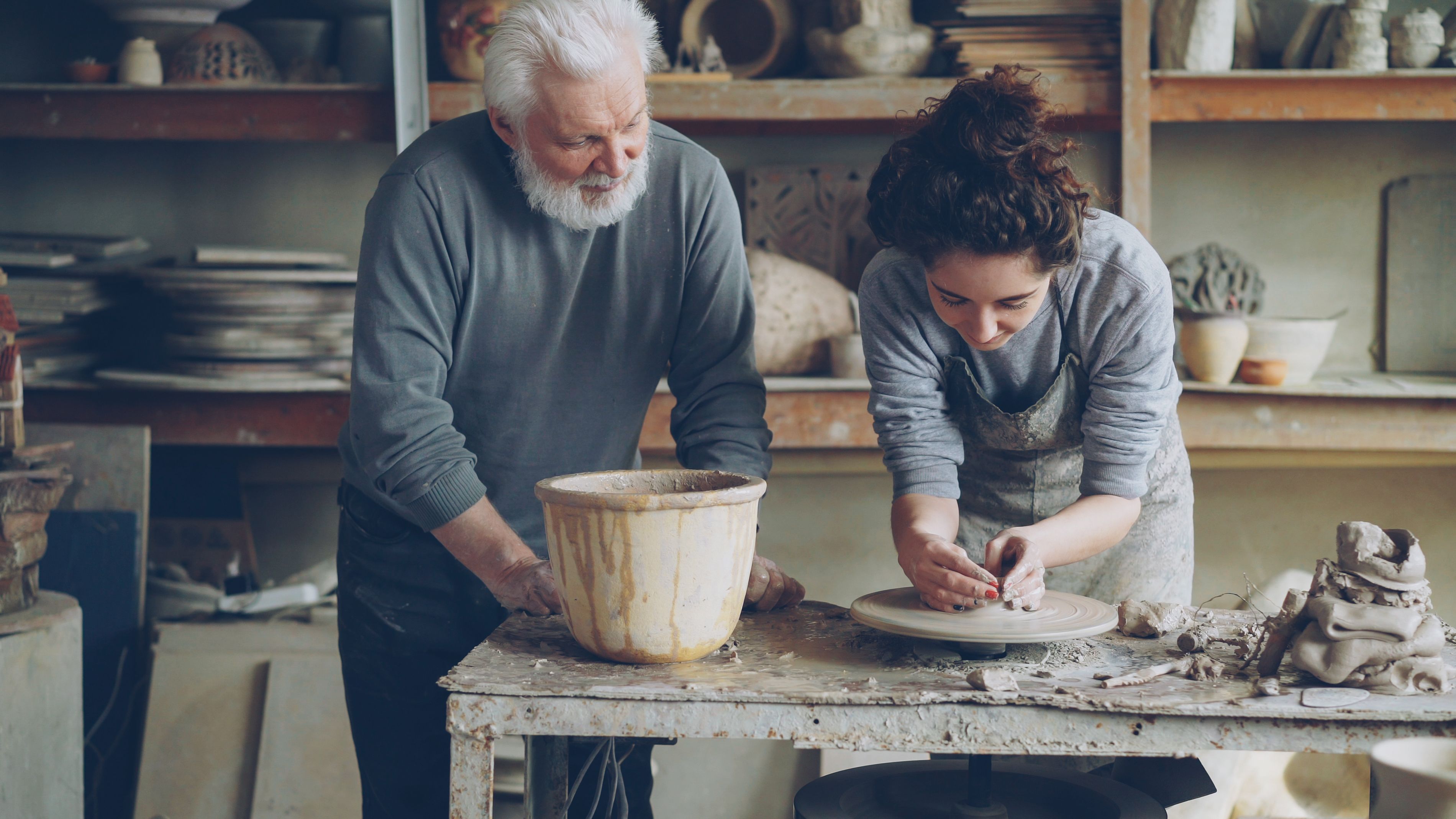
And then we find ourselves in our first dance class, surrounded by people who seem to have been born moving to music, while we're still trying to work out which foot is left and which is right.
Suddenly, we need instructions again. We ask basic questions. We make mistakes. Someone might have to demonstrate the same movement several times before we understand it.
Although all of this is a completely normal part of learning, it isn't always comfortable.
Research into leisure participation has identified psychological and other personal barriers as some of the reasons people don't take part in activities they'd like to pursue.
In 1991, researchers Duane Crawford, Edgar Jackson and Geoffrey Godbey described three groups of constraints: intrapersonal, interpersonal and structural.
Intrapersonal constraints can involve insecurity and perceptions of our own abilities. Interpersonal constraints may include a lack of company or support. Structural constraints include time, money, distance and other practical circumstances.
Interestingly, these obstacles often overlap.
Perhaps we'd like to try hiking but have nobody to go with. Maybe we're interested in martial arts but don't know whether there's a class for complete beginners. Or perhaps we'd love to take a painting course, except that sometime in primary school we decided we had no artistic talent.
And so, sometimes we give up on an experience before we've even given it a chance.
What does science tell us?
One particularly interesting study was published in the scientific journal eLife in 2023.
Researcher Kate Nussenbaum and her colleagues examined how children, adolescents and young adults make decisions when choosing between familiar and unfamiliar options.
The study involved 122 participants between the ages of 8 and 27.
The results showed that the tendency to explore decreased with age. However, the appeal of novelty itself did not show the same change. An important difference lay in attitudes towards uncertainty: older participants were more likely to avoid options whose outcomes they couldn't predict.
This doesn't prove that someone in their forties will turn down a new activity because they're afraid of the unknown. The research was conducted under controlled experimental conditions, and the oldest participants were 27.
Still, it raises an interesting possibility.
Perhaps new things still attract us, but knowing what to expect becomes increasingly important.
That may be why the first step sometimes feels much bigger than it actually is.
But science also offers encouraging findings about learning itself.
Psychologist Denise C. Park and her colleagues, in research known as the Synapse Project, investigated the effects of learning new, demanding skills among older adults.
Some participants spent three months intensively learning digital photography, quilting or both activities. These weren't one-off workshops, but sustained learning experiences requiring time, effort and the active development of new skills.
Participants in these groups showed improvements in certain aspects of episodic memory compared with participants who engaged in less demanding activities.
Of course, that doesn't mean every new hobby will automatically improve memory or prevent cognitive difficulties. Nor do the findings suggest that attending a single workshop can produce effects comparable to three months of intensive learning. They do, however, show that learning complex new skills can have measurable benefits later in adulthood.
Another important perspective comes from psychologist Rachel Wu at the University of California, Riverside.
In a conversation with the American Psychological Association (APA), she highlights the difference between how we approach learning in childhood and adulthood.
We allow children months or years to learn something. Adults, on the other hand, sometimes expect themselves to make progress after only a few attempts.
Wu also emphasises the importance of realistic expectations, feedback, support and environments where making mistakes is allowed.
Perhaps, instead of asking whether we're talented enough, we should more often ask ourselves a simpler question:
Have we actually given ourselves enough time to learn something?
Does everything have to become an achievement?
There's another interesting dimension to adult life.
We're often accustomed to thinking in terms of results.
If we learn a foreign language, we want to speak it fluently. If we start running, we soon begin thinking about distances, pace and races. If we try photography, after only a few attempts we might already be comparing our pictures with the work of people who have been practising for years.
Progress is natural and can be a powerful source of motivation.
But what if we don't want to become excellent at something?
What if we want to dance simply because we love music? Paint even though our paintings will never hang in a gallery? Learn a few guitar chords without the slightest intention of ever performing in public?
Not every activity has to become a skill that impresses other people.
Not every interest has to become a project.
And not every free moment has to be productive.
Sometimes, finding something interesting is enough.
Or perhaps what matters to us simply changes with age
It would be wrong to conclude that an adult who rarely tries new activities is necessarily missing out on life.
Psychologist Laura Carstensen, known for socioemotional selectivity theory, has studied how our perception of time influences our priorities in life.
According to this theory, when we perceive the future as open-ended and distant, we may be more drawn to experiences that help us acquire new knowledge and expand our possibilities.
When we begin to perceive time as more limited, relationships and activities that offer immediate emotional meaning may become more important.
This isn't a rule that applies to everyone, nor is it exclusively about chronological age.
But it offers an important counterpoint to the idea that we should always be searching for something new.
Perhaps someone in their twenties wants to discover as many places, people and activities as possible, while in their fifties they find greater enjoyment in a handful of familiar interests.
Perhaps someone spends their whole life trying new things.
And perhaps someone finds deep satisfaction in a single activity they've enjoyed and developed for years.
None of these possibilities is inherently less valuable than the others.
Curiosity doesn't always have to mean searching for something new. Sometimes, it can also take the form of wanting to understand something familiar more deeply.
Being a beginner is discussed more than we might think
The question of why starting something new can sometimes be difficult in adulthood isn't merely a topic of popular psychology. Scientists, journalists and authors have explored it from a range of perspectives.
American journalist and author Tom Vanderbilt explores his own experiences of learning new skills as an adult in his book Beginners: The Joy and Transformative Power of Lifelong Learning.
In an article published in Britain's The Guardian in 2021, he writes about returning to the role of a beginner, the discomfort it can bring and the value of learning something that doesn't necessarily serve a practical purpose.
Rachel Wu approaches the subject from the perspective of developmental and cognitive psychology, studying how adults learn and how that process might be made easier.
Interestingly, in 2026 The Guardian also published a series called My Rookie Era, dedicated to adults trying various activities for the first time.
Among the stories are attempts at archery, sports, hiking and other experiences. Some end in enthusiasm, others in frustration, and many illustrate just how uncomfortable and enjoyable being a beginner can be at the same time.
In Croatia, research into adult education, including the work of sociologist Teo Matković, raises further questions about access to opportunities and the barriers we sometimes oversimplify.
Different authors, different methods and different contexts.
But one shared question:
What encourages us to keep learning and exploring, and what holds us back?
Maybe it's not about courage, but permission
After considering all of this, it seems there is no single answer to why trying something new can sometimes feel harder as an adult.
For some, it's time and responsibilities. For others, finances or a lack of opportunities. Some are held back by insecurity, fear of making mistakes or the feeling that, at their age, they should already know what they're doing.
And some people simply don't feel the need for new activities because they're happy with what they already have.
And that's okay.
Still, perhaps it's worth thinking about all those things that interest us but that we've never actually tried.
Not because we constantly need to step outside our comfort zones.
Not because we should collect as many experiences as possible or prove how capable we are.
But because being an adult doesn't have to mean we're finished discovering.
We can still ask questions we don't know the answers to. We can learn something entirely new, meet different people, explore unfamiliar subjects and be completely clumsy in the process.
We can give something a try and discover that we don't like it at all.
And that's an experience too.
Maybe we don't have to be good at everything. Maybe we simply need to give ourselves permission to be beginners again.